
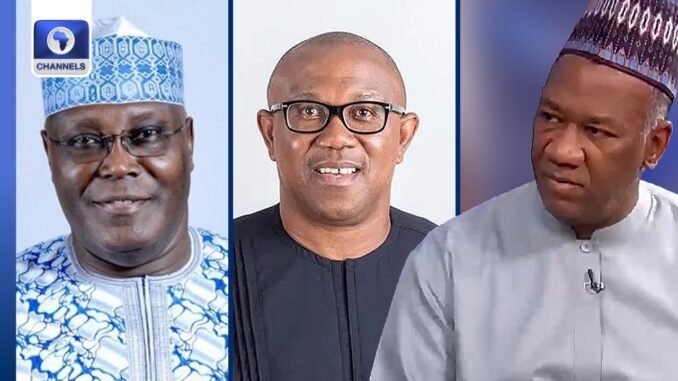

Summary: Former LP VP candidate Datti Baba-Ahmed says Atiku Abubakar missed a golden opportunity to secure the 2027 presidency by not backing Peter Obi in 2023. Read the full details of this political revelation.
The political arena is buzzing with a shocking revelation from Yusuf Datti Baba-Ahmed, the former vice-presidential candidate of the Labour Party (LP). In a statement that has sent ripples across Nigeria’s political landscape, Baba-Ahmed declared that former Vice President Atiku Abubakar would have been on a clear path to winning the 2027 presidential election—if only he had made one crucial decision in 2023.
The Missed Political Masterstroke
According to Datti Baba-Ahmed, Atiku’s failure to support Peter Obi during the 2023 presidential election was a strategic blunder of epic proportions. The former LP running mate argues that backing the Obidient movement would have positioned the Wazirin Adamawa as the natural successor and frontrunner for the 2027 polls.
“If Atiku had thrown his weight behind Peter Obi in 2023, he would have been the undisputed favourite for the 2027 presidency,” Baba-Ahmed stated, highlighting what he considers a critical miscalculation in Atiku’s political playbook.
Why This Matters for Nigerian Politics
For those who followed the 2023 elections closely, the three-way battle between Atiku Abubakar (PDP), Bola Ahmed Tinubu (APC), and Peter Obi (LP) remains one of the most contentious in Nigeria’s democratic history. The emergence of the “Obidient” movement, particularly among Nigerian youths and diaspora communities, reshaped the political conversation.
Baba-Ahmed’s assertion suggests that Atiku could have capitalized on this wave of popular support by endorsing Obi, thereby creating a political alliance that would have benefited him in the long run. The logic? By helping Obi potentially secure victory in 2023, Atiku would have earned the goodwill and loyalty of millions of Nigerians, positioning himself as the heir apparent for 2027.
The Politics of Self-Interest vs. Strategic Thinking
This revelation raises important questions about Nigerian political calculations. Did Atiku’s ambition to win at all costs blind him to a potentially more rewarding long-term strategy?
Many political analysts have often criticized Nigerian politicians for prioritizing immediate personal gain over strategic alliances that could yield better results. Baba-Ahmed’s comments seem to echo this sentiment, suggesting that Atiku’s decision to contest rather than collaborate may have been shortsighted.
What This Means for 2027
As we look toward the 2027 elections, Baba-Ahmed’s statement serves as a reminder that political fortunes in Nigeria can shift dramatically based on strategic decisions made years in advance. With Atiku having now contested the presidency multiple times without success, questions about his political future remain unanswered.
Will the former Vice President contest again in 2027? Would he consider a different approach this time around? And most importantly, can he still rebuild the bridges that might have been burned during the heated 2023 campaign?
The Bigger Picture
Beyond the personalities involved, this discussion highlights the importance of coalition-building in Nigerian politics. In a country as diverse and complex as ours, perhaps the path to Aso Rock lies not in individual ambition alone, but in the ability to forge strategic alliances and think beyond the immediate election cycle.
Datti Baba-Ahmed’s remarks may be controversial, but they’ve certainly added another layer to the ongoing conversation about Nigeria’s political future. Whether you agree with his assessment or not, one thing is clear: the lessons from 2023 will continue to shape the strategies of those eyeing 2027.
What do you think? Was Atiku’s decision to contest against Obi a strategic error, or was he right to pursue his own ambition? Drop your thoughts in the comments below.
Stay connected for more updates on Nigerian politics and the journey toward 2027.
For more information, check buzzUp9ja
Be the first to comment