
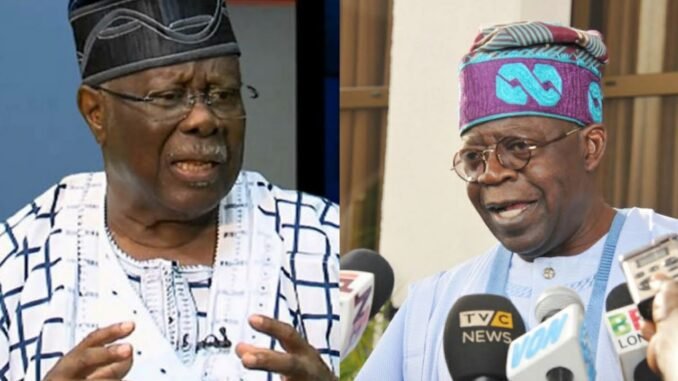

Former Deputy National Chairman of the Peoples Democratic Party (PDP), Chief Olabode George, has waded into the ongoing national conversation about Nigeria’s deteriorating security situation, offering a different perspective on who should be held accountable.
The PDP chieftain’s comments come in response to a recent ultimatum issued by the General Overseer of the Redeemed Christian Church of God (RCCG), Pastor Enoch Adeboye, directed at Nigeria’s Service Chiefs regarding the country’s security challenges.
The Constitution is Clear: Tinubu is Commander-in-Chief
Chief George, in his characteristic direct manner, emphasized that according to the Nigerian Constitution, President Bola Ahmed Tinubu holds the ultimate responsibility for the nation’s security as the Commander-in-Chief of the Armed Forces.
“Any advice or ultimatum concerning our security situation should be directed at the President, not the Service Chiefs,” George stated, reminding Nigerians of the constitutional chain of command.
The former military officer turned politician explained that while the Service Chiefs play crucial operational roles, they function under the direct supervision and orders of the President. Therefore, he argued, holding them solely accountable without addressing the President’s role misses the point entirely.
Understanding the Chain of Command
George’s position highlights an important constitutional reality that sometimes gets lost in public discourse. The Service Chiefs—comprising the Chief of Defence Staff, Chief of Army Staff, Chief of Naval Staff, and Chief of Air Staff—are appointees of the President who serve at his pleasure.
These military leaders implement security policies and strategies approved by the Commander-in-Chief. While they certainly bear responsibility for execution, the ultimate authority for Nigeria’s security architecture rests with President Tinubu.
A Growing National Concern
The backdrop to this exchange is Nigeria’s worsening insecurity crisis. From banditry in the Northwest to insurgency in the Northeast, armed herders’ attacks in the Middle Belt, kidnappings across multiple states, and separatist agitations in the Southeast, Nigerians are experiencing security challenges on multiple fronts.
Pastor Adeboye’s recent comments reflected the frustration many religious leaders, traditional rulers, and ordinary citizens feel about the seemingly unending violence. His call for accountability from the Service Chiefs resonated with many Nigerians who are desperate for solutions.
However, Chief George’s intervention reminds us that accountability must follow the proper channels and constitutional framework.
Political Implications
George’s statement also carries political weight, coming from a prominent opposition figure. By redirecting focus to President Tinubu, the PDP chieftain is essentially calling for presidential accountability—a theme likely to feature prominently as Nigeria approaches the next election cycle.
The comment could be seen as the opposition’s way of ensuring that the ruling All Progressives Congress (APC) and President Tinubu specifically don’t escape responsibility for the security situation under their watch.
What This Means for Nigerians
For everyday Nigerians struggling with the reality of insecurity—whether it’s farmers unable to access their farmlands, travelers afraid of highways, or families living in fear of kidnapping—the debate about who to hold accountable might seem academic.
What matters most is action and results. However, understanding where responsibility truly lies is crucial for effective advocacy and accountability.
Citizens, civil society organizations, and religious leaders like Pastor Adeboye must know that while engaging with Service Chiefs is important, sustainable change in security policy and strategy must come from the presidency.
The Way Forward
Chief George’s intervention serves as a reminder that addressing Nigeria’s security challenges requires:
1. Presidential Leadership: Clear, decisive action from President Tinubu as Commander-in-Chief
2. Proper Accountability: Holding the right offices responsible according to constitutional provisions
3. Adequate Resources: Ensuring security agencies have the tools, training, and motivation needed
4. Comprehensive Strategy: Moving beyond military solutions to address underlying socio-economic factors
5. National Unity: Building consensus across political, ethnic, and religious lines
Conclusion
As the debate continues, one thing remains clear: Nigeria’s security challenges demand urgent, coordinated action from the highest levels of government. Whether advice comes from respected religious leaders like Pastor Adeboye or political figures like Chief Bode George, the message is the same—Nigerians are demanding better security and accountability from their leaders.
Chief George’s reminder about constitutional responsibility isn’t about shielding the Service Chiefs from scrutiny but ensuring that pressure for change is applied where it can be most effective—at the desk of the Commander-in-Chief himself.
The question now is: Will President Tinubu rise to the challenge and provide the decisive leadership Nigerians desperately need on security?
—
What do you think? Should religious leaders direct their advice to the President or the Service Chiefs? Share your thoughts in the comments below.
For more information, check buzzUp9ja
Be the first to comment