
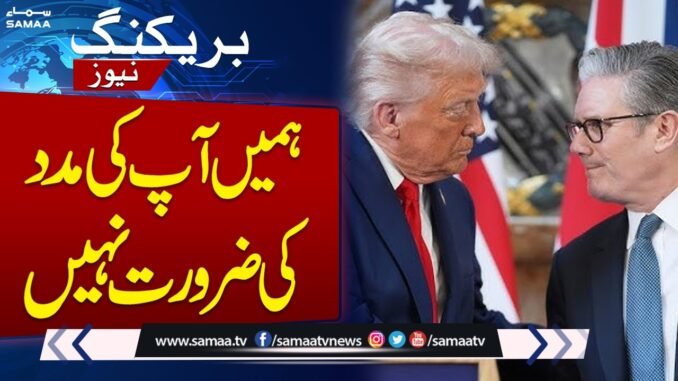

Summary: US President Donald Trump publicly criticizes Britain over delayed military support in Iran conflict, saying America doesn’t need UK’s aircraft carriers. Tensions rise between traditional allies as PM Starmer defends careful decision-making approach.
In a blunt social media statement that has set tongues wagging across the Atlantic, US President Donald Trump has told Britain that America doesn’t need British military support to win the ongoing conflict with Iran—even as the UK considers deploying aircraft carriers to the volatile Middle East region.
The American leader, never one to mince words, took to his Truth Social platform to express his displeasure with what he sees as Britain’s late arrival to the conflict party.
“The United Kingdom, our once great ally, maybe the greatest of them all, is finally giving serious thought to sending two aircraft carriers to the Middle East,” Trump wrote. “That’s OK, Prime Minister Starmer, we don’t need them any longer. But we will remember. We don’t need people that join wars after we’ve already won.”
The Quarrel Between Old Allies
For those following international politics, this latest exchange is more than just typical Trump bombast—it signals a serious crack in what has historically been one of the world’s strongest military alliances, often called the “special relationship.”
The tension began when Britain initially blocked the United States from using British military bases for strikes on Iran. British Prime Minister Keir Starmer defended the decision, insisting that his government needed to ensure any military action was both legal and carefully planned before offering support.
Britain later softened its position, allowing American forces to use its bases for what officials described as defensive operations—specifically targeting Iranian missile depots and launchers. But the initial hesitation appears to have left a bitter taste in Trump’s mouth.
UK Prepares HMS Prince of Wales
Despite Trump’s dismissive comments, Britain is moving ahead with military preparations. The UK’s defence ministry confirmed it is readying the aircraft carrier HMS Prince of Wales for possible deployment to the Middle East, though officials stress that no final decision has been made.
The HMS Prince of Wales is one of Britain’s most advanced warships, capable of carrying dozens of fighter jets and serving as a mobile command centre for complex military operations.
Britain’s Response: “We Won’t Be Rushed”
British Home Secretary Yvette Cooper responded to Trump’s social media jabs with characteristic British restraint. She said the government would focus on practical, carefully considered decisions rather than reacting to political rhetoric or social media provocations.
“British leaders prefer calm and steady decision-making rather than reacting to social media statements,” Cooper said, in what many observers interpreted as a subtle dig at Trump’s tweet-first, think-later approach to diplomacy.
A Relationship Under Strain
This latest spat is just the newest chapter in what has been a rocky year for US-UK relations. Trump has repeatedly criticised Starmer in recent days, accusing the British Prime Minister of damaging the traditionally close partnership between the two nations.
Other sources of tension include Trump’s controversial proposal to purchase Greenland from Denmark, and his public criticism of European troops’ performance in Afghanistan—comments that have not sat well with European allies, including Britain.
What This Means for Global Politics
For Nigerians and others watching from outside the Western bubble, this public disagreement between two of the world’s most powerful nations offers important lessons. It shows that even the strongest alliances can fray when national interests diverge, and that the era of automatic Western unity on military matters may be coming to an end.
It also demonstrates the unpredictable nature of Trump’s foreign policy approach—one that values loyalty and quick action over the careful diplomatic choreography that has traditionally governed relations between major powers.
As the situation in the Middle East continues to evolve, the world will be watching to see whether Britain and America can patch up their differences—or whether this “special relationship” will continue to show cracks under the weight of diverging priorities and clashing political personalities.
Get more insight on buzzUp9ja
Be the first to comment