
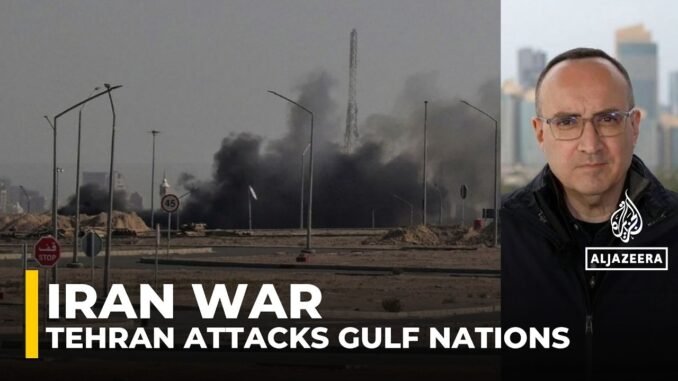

Summary: Iranian strikes hit Kuwait International Airport and Bahrain’s desalination facility as Gulf states face second week of regional conflict. At least 16 killed across the region.
The Persian Gulf is burning with tension as Iran unleashed another round of missile and drone attacks on Sunday, March 8, targeting critical infrastructure across Kuwait and Bahrain. This dangerous escalation marks the second week of a regional crisis that threatens to drag the entire Gulf into open warfare.
Kuwait Airport Under Fire
The situation turned deadly serious when Iranian drones struck fuel storage tanks at Kuwait International Airport. Although firefighters quickly brought the blaze under control and no major casualties were reported at the airport itself, the attack represents a direct assault on one of the region’s busiest aviation hubs.
The news gets worse. Kuwait’s Interior Ministry confirmed that two border guards lost their lives “while performing their national duty,” though full details of the incident remain unclear. Kuwait’s national oil company has already announced precautionary cuts to crude oil production as the country braces for more attacks.
The country’s main social security building was also hit, forcing authorities to close it to the public due to material damage. Debris from missiles shot down by defence systems scattered across civilian areas, damaging multiple facilities.
Bahrain’s Water Supply Threatened
In Bahrain, Iranian drones damaged a crucial water desalination plant—a lifeline for the island nation that depends heavily on such facilities for drinking water. Bahrain’s Interior Ministry accused Tehran of “randomly targeting civilian infrastructure,” a charge that underscores the indiscriminate nature of these attacks.
Iran’s Islamic Revolutionary Guard Corps (IRGC) claimed they were targeting the United States’ Naval Support Activity Bahrain, alleging the base was used to launch attacks on an Iranian desalination facility. Whether this justifies striking civilian water infrastructure is a question many across the Gulf are now asking.
Fortunately, Bahrain’s authorities confirmed that water supplies remained unaffected despite the damage. However, three people were injured by falling missile debris in the Muharraq area, and a university building sustained damage.
The Bigger Picture: Gulf States in the Crossfire
Since this conflict began—triggered by large-scale American and Israeli strikes on Iranian targets—neighbouring Gulf countries have found themselves bearing the brunt of Tehran’s retaliation. According to AFP’s count, at least 16 people have died across the region, including eight civilians caught in the crossfire.
The weekend saw attacks reported in:
– Saudi Arabia: Air defence systems intercepted 33 drones, including strikes aimed at Riyadh’s diplomatic quarter and the strategic Shaybah Oil Field
– United Arab Emirates: Defence systems activated to counter incoming threats as the country declared itself in “a period of war”
– Qatar: Ten ballistic missiles and two cruise missiles fired from Iran, mostly intercepted
– Dubai: A Pakistani national killed by falling debris; Dubai International Airport briefly closed after an interception near the facility
Mixed Messages from Tehran
Iranian President Masoud Pezeshkian has sent confusing signals. On Saturday, he apologized to Gulf states hosting US military bases for strikes on their territory. Yet just a day later, he warned that Tehran would continue attacking if neighbouring countries allowed their land to be used against Iran.
Iran’s judiciary chief doubled down on this threat, warning that attacks would persist on Gulf sites “at the disposal of the enemy.”
What This Means for Nigeria and Africa
While this conflict plays out thousands of kilometres away, Nigerians should pay close attention. Any prolonged instability in the Gulf could:
– Spike global oil prices, affecting petrol costs at Nigerian pumps
– Disrupt remittances from the estimated 100,000+ Nigerians working across the Gulf states
– Impact air travel, as Gulf airports serve as major connection points for African travellers
– Affect trade routes that Nigeria depends on for imports
The UAE’s Mohammed bin Zayed Al Nahyan struck a defiant tone, telling his nation in a televised address that despite being in “a period of war,” the country would emerge stronger. That’s small comfort for the civilians—including foreign workers from across Asia and Africa—now living under the shadow of missile strikes.
As this crisis enters its third week, one thing is clear: the Gulf states, despite their wealth and advanced defence systems, are vulnerable. And when the Gulf sneezes, the rest of the world—including Nigeria—catches cold.
Stay tuned for updates as this developing story continues to unfold.
For more details, check buzzUp9ja
Be the first to comment