
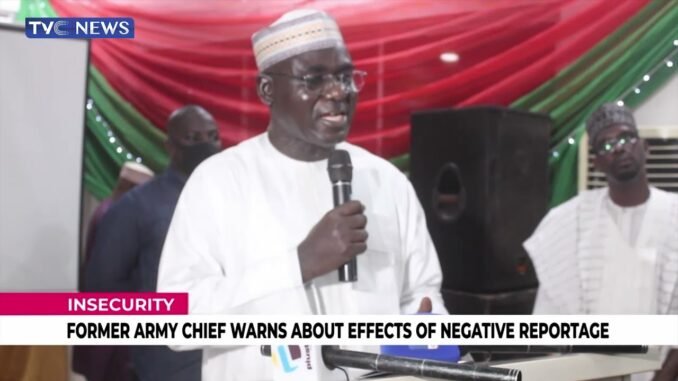

Summary: Former Chief of Army Staff Tukur Buratai claims Nigerian politicians exploit insecurity for political gain, alleging that banditry and kidnappings escalate during political transitions.
The persistent security challenges plaguing Nigeria may have more to do with political calculations than meets the eye, according to a former Chief of Army Staff, Lt. Gen. Tukur Buratai (retd.).
In a statement that has sparked conversations across the country, Buratai drew a direct connection between Nigeria’s recurring security crises—including banditry, kidnappings, and the disturbing trend of school abductions—and the activities of politicians during transition periods.
The Political Angle to Insecurity
The former military chief’s allegations suggest that some Nigerian politicians deliberately exploit or even fuel insecurity to advance their political ambitions. According to Buratai, these security challenges tend to intensify during political transitions, raising questions about who truly benefits when ordinary Nigerians live in fear.
This claim echoes concerns many Nigerians have harboured for years. From the North-East to the North-West, and even parts of the Middle Belt, communities have watched helplessly as banditry, terrorism, and kidnappings have become almost routine occurrences. The pattern of these attacks often seems to align suspiciously with political calendars—escalating before elections and sometimes during crucial political moments.
A Pattern Nigerians Recognize
For the average Nigerian, Buratai’s statement may not come as a complete surprise. Many have observed how security issues become campaign fodder, with politicians promising solutions to problems that mysteriously worsen under their watch. The cynical joke in many Nigerian homes is that insecurity has become a “business” for some people who profit from the chaos.
The former Army Chief’s position carries particular weight given his frontline experience combating insurgency during his tenure. His insider perspective on military operations and the political landscape adds credibility to these serious allegations.
The Human Cost
While politicians allegedly play games with security, real Nigerians pay the price. Parents in states like Kaduna, Zamfara, and Katsina live in constant fear of their children being abducted from schools. Farmers have abandoned their lands, unable to work without risking kidnapping or death. Travellers along major highways plan their journeys around bandit attack schedules.
The economic impact is equally devastating. Businesses struggle to operate in insecure environments, investments flee to safer countries, and Nigeria’s reputation suffers on the global stage.
Questions That Demand Answers
Buratai’s allegations raise critical questions that Nigerian authorities must address:
– Who exactly benefits from sustained insecurity in Nigeria?
– What mechanisms exist to investigate the alleged connections between politicians and criminal elements?
– How can Nigeria break the cycle of politically-motivated violence?
– What role should anti-corruption agencies play in investigating these claims?
The Way Forward
If there is truth to these allegations—and many Nigerians suspect there is—then addressing Nigeria’s security crisis requires more than military solutions. It demands political will to confront powerful interests that may profit from chaos.
Nigerians deserve leaders who prioritize national security over political advantage. The country needs a comprehensive security overhaul that includes not just military strategy but also political accountability and transparency.
As the 2027 elections approach, Buratai’s warning becomes even more relevant. Vigilant citizens must watch for suspicious patterns, demand accountability from leaders, and refuse to be manipulated by politicians who weaponize their fears for political gain.
The question remains: Will Nigerian authorities investigate these serious allegations, or will they be swept under the rug like so many other uncomfortable truths? Only time—and the political will of those in power—will tell.
For now, ordinary Nigerians continue to bear the burden of insecurity while waiting for the day when their safety stops being a political bargaining chip.
For more information, check buzzUp9ja
Be the first to comment