
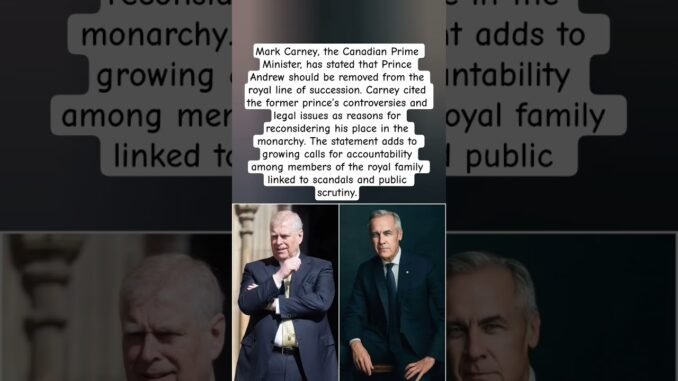

Canada’s Prime Minister, Mark Carney, has publicly stated that Prince Andrew should be stripped of his position in the line of succession to the British throne, citing what he described as the royal’s “deplorable” behaviour.
Andrew Mountbatten-Windsor currently faces investigation for alleged misconduct in public office. The controversy stems from his well-documented connections to Jeffrey Epstein, the late American financier who was convicted of sex offences. According to reports, Prince Andrew was arrested in February and subsequently released on suspicion of passing confidential information to Epstein during his tenure as a UK trade envoy between 2001 and 2011.
Speaking to reporters during an official visit to Tokyo for talks with Japanese Prime Minister Sanae Takaichi, Carney didn’t mince words: “There is a process in order to do it… but I certainly think his actions which are deplorable and have caused him to be stripped of his royal titles, certainly… necessitate his removal from the line of succession.”
Background to the Controversy
Prince Andrew was already stripped of his royal titles last year following the mounting controversy surrounding his alleged association with Epstein. Despite the scandal, he has consistently denied any wrongdoing.
The most serious allegations came from Virginia Giuffre, one of Epstein’s accusers, who claimed she was trafficked and forced to have sexual relations with the British royal on multiple occasions beginning in 2001. In 2022, Andrew reached a settlement in a civil lawsuit filed by Giuffre in the United States, though he did not admit liability as part of the agreement.
Growing International Pressure
Prime Minister Carney’s comments align with similar sentiments expressed by governments in Australia and New Zealand, both of which have indicated support for removing Andrew from the royal line of succession. This growing international consensus among Commonwealth nations puts additional pressure on the British monarchy to act.
However, any change to the succession line would need to be initiated by the United Kingdom itself and would require the agreement of all 14 other Commonwealth realms that recognize King Charles III as their head of state—a complex constitutional process that involves multiple governments.
What This Means for the Monarchy
The situation highlights the delicate balance the British monarchy must maintain between tradition and modern expectations of accountability. As Commonwealth nations—including major realms like Canada, Australia, and New Zealand—voice their concerns, the pressure mounts for the UK to address the ongoing scandal surrounding Prince Andrew.
For many observers, the controversy raises broader questions about the future of the monarchy and its relevance in the 21st century, particularly in Commonwealth countries where republican sentiments have been growing in recent years.
check buzzUp9ja for more details
Be the first to comment