
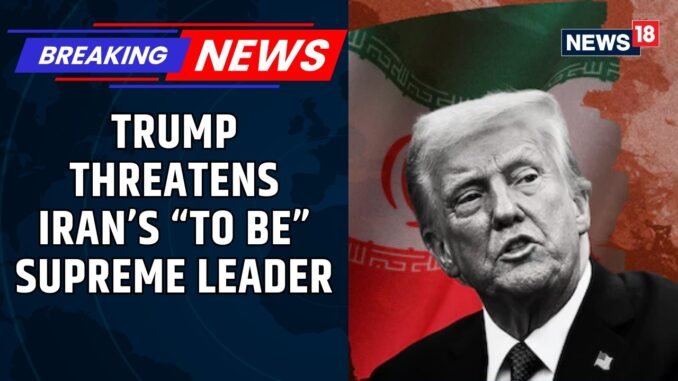

As tensions escalate in the Middle East following the death of Ayatollah Ali Khamenei, US President Donald Trump has declared that Iran’s incoming leader will need American backing to remain in power—a statement Tehran has firmly rejected.
Nine days after coordinated US-Israeli military strikes claimed the life of Iran’s Supreme Leader Ayatollah Ali Khamenei, plunging the region into deeper crisis, Iran’s Assembly of Experts has quietly selected his successor during a closed-door meeting.
The identity of the chosen leader remains under wraps for now, though the clerical body has promised to make an announcement “soon.” Speculation is rife that 56-year-old Mojtaba Khamenei, son of the late supreme leader, may inherit his father’s position—a prospect that has already drawn sharp criticism from Washington.
Trump Issues Warning to Tehran
In a bold declaration that has raised eyebrows across diplomatic circles, President Trump made clear that any new Iranian leader will require American consent to maintain authority.
“He’s going to have to get approval from us,” Trump told ABC News, referring to whoever emerges as Iran’s next supreme leader. “If he doesn’t get approval from us, he’s not going to last long.”
The US president has already dismissed Mojtaba Khamenei as a potential successor, branding him an unacceptable “lightweight” unfit for leadership.
Iran Fires Back: “This Is Our Internal Matter”
Tehran’s response was swift and unequivocal. Iran’s Foreign Minister Abbas Araghchi pushed back against what he characterized as unwarranted foreign meddling in Iranian affairs.
Speaking on NBC’s Meet the Press, Araghchi emphasized that selecting a new supreme leader is “an internal matter for Iran” and warned that the Islamic Republic would not tolerate outside interference in its domestic decisions.
In a pointed rebuke, the foreign minister also called on President Trump to apologize to the people of the Middle East for the escalating violence that has engulfed the region.
Who Is Mojtaba Khamenei?
The younger Khamenei, widely seen as a conservative hardliner, maintains strong connections with Iran’s Revolutionary Guards—the ideological backbone of the country’s military establishment. These ties have made him a favored candidate among certain factions within Iran’s power structure.
However, Israel has issued its own warning: any successor to the late Ayatollah could become a military target if hostilities continue.
Conflict Intensifies Across the Region
The war shows no signs of slowing down. Overnight, Israeli forces launched fresh strikes across multiple Iranian targets, demonstrating the expanding scope of military operations.
Air raids hit five fuel storage facilities in and around Tehran, killing at least four people and blanketing the capital in thick, acrid smoke. A separate strike targeted a hotel in central Beirut suspected of housing Iranian military commanders.
Tehran’s governor confirmed that fuel distribution in the capital had been temporarily disrupted, while residents of the city—home to roughly 10 million people—reported a dark haze obscuring the skyline.
Authorities warned that fumes from the burning facilities could be toxic, advising citizens to remain indoors. One Tehran resident described the scene: “The fires have been burning for over 12 hours. The air is hard to breathe, and many of us are staying inside.”
Iran Vows to Fight On
Despite the devastating strikes, Iran’s Revolutionary Guards claim the country possesses sufficient resources to sustain drone and missile attacks for up to six months.
The conflict entered its ninth day with fresh missile launches toward Israel. Explosions echoed over Tel Aviv after Israeli defense systems detected incoming projectiles, with emergency services reporting at least six injuries in central Israel.
An Iranian military spokesman revealed that Tehran has so far deployed only “first- and second-generation missiles,” warning that more sophisticated long-range weaponry could be unleashed in coming days.
Trump Refuses to Rule Out Ground Invasion
When pressed on whether the United States might deploy ground troops to Iran, President Trump declined to rule out the possibility, though he maintained that the war was nearing conclusion—despite ongoing attacks.
Trump also held discussions with British Prime Minister Keir Starmer on Sunday to coordinate military cooperation. The UK has granted American forces access to British bases for what London describes as “collective self-defence operations” in the region.
What This Means for Nigeria and Africa
As global oil markets react nervously to strikes on Iranian energy infrastructure, countries like Nigeria—heavily dependent on stable energy prices—may face economic ripple effects. Any prolonged disruption to Middle Eastern oil supplies could impact fuel costs and energy security across Africa.
The escalating conflict also raises broader questions about international sovereignty and the role of global powers in determining leadership transitions in sovereign nations—issues that resonate deeply across the African continent, where foreign intervention has historically shaped political outcomes.
—
As the situation continues to develop, the world watches to see whether diplomatic channels can prevail, or if the Middle East is heading toward an even broader confrontation with unpredictable consequences for global stability.
Want more details, click here: buzzUp9ja
Be the first to comment