
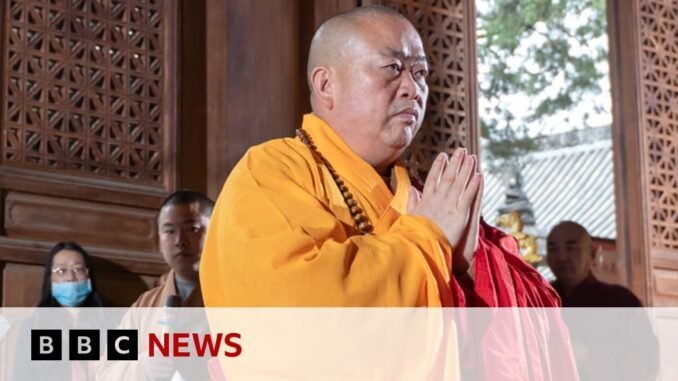

The former leader of one of China’s most iconic religious sites has been handed a severe prison sentence that has sent shockwaves through the martial arts community and beyond.
Shi Yongxin, who once headed the legendary Shaolin Temple—the birthplace of kung fu that has inspired countless martial arts films and attracted visitors from around the world—has been sentenced to 24 years behind bars. The Chinese court also slapped him with a hefty fine of 3.5 million yuan (approximately N517 million or $517,000).
What Did He Do?
The disgraced temple leader was convicted on multiple serious charges, including embezzlement and bribery. These crimes paint a troubling picture of corruption at one of China’s most revered cultural and spiritual landmarks.
The Shaolin Temple, nestled in China’s Henan Province, is more than just a tourist attraction. For over 1,500 years, it has stood as a symbol of Chinese martial arts tradition, Buddhist spirituality, and cultural heritage. The temple has trained generations of monks in the ancient art of kung fu, and its influence has spread globally through movies, documentaries, and martial arts schools.
A Fall From Grace
Shi Yongxin’s conviction represents a dramatic fall from grace. As the abbot of Shaolin Temple, he wielded significant influence not just within the religious community but also in China’s cultural and tourism sectors. The temple, under his leadership, had become increasingly commercialized, generating substantial revenue from tourism, performances, and merchandise.
However, this commercialization appears to have come with a dark side. The embezzlement and bribery charges suggest that Shi Yongxin allegedly diverted funds meant for the temple and its operations for personal gain.
Why Nigerians Should Care
While this story originates from China, it carries universal lessons about accountability, especially for those in positions of spiritual and cultural leadership.
For Nigerians, who deeply value religious institutions and trust religious leaders with both spiritual guidance and material resources, this case serves as a sobering reminder. Whether it’s a church, mosque, or traditional institution, the principle remains the same: those who lead must be held to high standards of integrity and transparency.
The Chinese government’s willingness to prosecute such a high-profile religious figure also demonstrates that no one should be above the law—a message that resonates in Nigeria, where accountability in leadership remains a critical national conversation.
The Legacy of Shaolin Temple
Despite this scandal, the Shaolin Temple’s legacy as the cradle of kung fu remains intact. The ancient martial art continues to captivate people worldwide, including in Nigeria, where kung fu movies from the Bruce Lee and Jackie Chan eras have long been beloved.
The temple itself will likely continue to attract martial arts enthusiasts and tourists, though this conviction will undoubtedly remain a stain on its recent history.
The Bottom Line
Shi Yongxin’s 24-year sentence sends a clear message: corruption and abuse of power will be punished, regardless of one’s position or prestige. For a man who once stood at the helm of one of the world’s most famous spiritual institutions, this represents not just a legal consequence but a profound moral failure.
As the saying goes, “Power corrupts, and absolute power corrupts absolutely.” This case proves that even in the sacred halls of a kung fu temple, justice must prevail.
—
What do you think about this case? Should religious leaders face stricter accountability measures? Share your thoughts in the comments below.
Read more on buzzUp9ja
Be the first to comment