
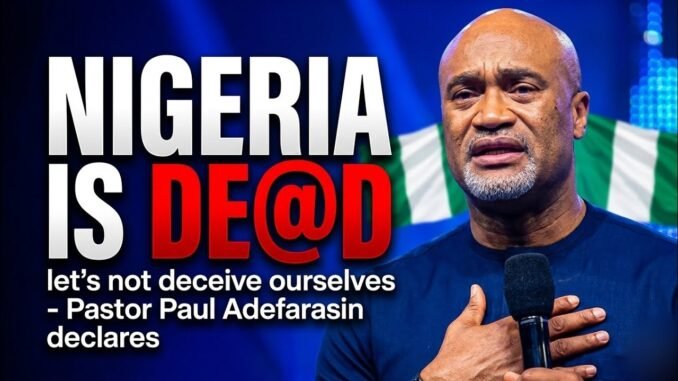

Summary: House on the Rock Senior Pastor Paul Adefarasin delivers shocking sermon declaring Nigeria economically dead, stating “once you’re counting in Naira, you are poor.” Watch the viral video and read his full message.
In a sermon that has set social media ablaze and sparked nationwide conversation, Pastor Paul Adefarasin, the respected Senior Pastor of House on the Rock Church, didn’t mince words about Nigeria’s current economic reality. His message? Nigeria is “dead and rotten,” and if you’re still counting your wealth in Naira, you’re essentially poor.
The Viral Sermon That Got Everyone Talking
During a recent service to his congregation, the influential clergyman delivered what many are calling a “prophetic wake-up call” about the dire state of Nigeria’s economy. His words, captured on video and now circulating widely across social media platforms, have resonated with millions of Nigerians who are struggling daily with the harsh economic realities in the country.
“Let’s not deceive ourselves,” Pastor Adefarasin declared emphatically. “Once you are counting in Naira, you are poor.”
Why His Words Strike a Chord
For many Nigerians, these words aren’t just controversial statements from a pulpit—they’re lived experiences. With the Naira’s continuous depreciation against major foreign currencies, particularly the US Dollar and British Pound, the purchasing power of average Nigerians has been severely eroded.
Consider this: What N10,000 could buy you five years ago barely scratches the surface today. Fuel prices have skyrocketed, food inflation has made even basic staples expensive, and many middle-class families now struggle to maintain their previous standard of living.
The Economic Reality Check
Pastor Adefarasin’s statement about Nigeria being “dead and rotten” economically reflects the frustration many citizens feel about:
– Hyperinflation: Food prices increasing almost weekly
– Currency devaluation: The Naira trading at unprecedented lows
– Rising cost of living: Basic necessities becoming luxury items
– Unemployment: Millions of qualified graduates without jobs
– Business collapse: Small and medium enterprises shutting down daily
Mixed Reactions From Nigerians
As expected, the pastor’s frank assessment has divided opinion. While many applaud his courage to speak truth to power and acknowledge the reality ordinary Nigerians face, others feel his statement is too harsh or potentially unpatriotic.
On Twitter (X) and other social media platforms, Nigerians have shared their experiences:
“Pastor Paul said nothing but the truth. If you’re earning N200k monthly, you’re technically poor by global standards,” one user wrote.
Another countered: “We need hope and solutions, not declarations of death. What happens after we accept we’re dead?”
Is There Hope Beyond the Naira?
While Pastor Adefarasin’s message may seem pessimistic, many interpret it as a call to action—a challenge for Nigerians to think beyond traditional economic limitations and explore alternative means of wealth creation and preservation.
This might include:
– Diversifying income in foreign currencies: Freelancing, remote work, or export businesses
– Investment in digital assets: Though risky, some Nigerians are exploring cryptocurrency and other alternatives
– Skills acquisition: Learning in-demand global skills that command foreign currency payment
– Entrepreneurship: Creating businesses that generate or save foreign exchange
The Bigger Conversation
Beyond the shock value, Pastor Adefarasin’s statement has reignited important conversations about Nigeria’s economic direction, leadership accountability, and the future we’re building for the next generation.
His words have joined a growing chorus of voices—from economists to everyday citizens—calling for urgent, substantive economic reforms and a re-evaluation of policies that have led to the Naira’s continuous decline.
What This Means for the Average Nigerian
The harsh reality is that Pastor Adefarasin’s observation reflects what many Nigerians already know but perhaps haven’t articulated so bluntly. The question now becomes: What do we do with this truth?
Do we:
– Despair and give up?
– Migrate in search of better opportunities (the “japa” syndrome)?
– Stay and fight to rebuild the economy?
– Adapt and find creative ways to thrive despite the challenges?
Final Thoughts
Whether you agree with Pastor Paul Adefarasin’s assessment or not, his statement has succeeded in forcing a national conversation about Nigeria’s economic reality. Sometimes, the first step to healing is acknowledging the depth of the wound.
The question remains: Will Nigeria’s leadership and citizens rise to address these fundamental economic challenges, or will we continue to pretend that all is well while the Naira—and by extension, our collective purchasing power—continues its freefall?
What do you think about Pastor Adefarasin’s statement? Is he right, or is there still hope for the Naira and Nigeria’s economy? Share your thoughts in the comments below.
Stay updated on the latest Nigerian news, economic analysis, and trending stories by subscribing to our newsletter.
For more information, check buzzUp9ja
Be the first to comment